Monday, 5 November 2012

Conventions of Film Noir

''Between the Great Depression and the start of the Cold War, 
Hollywood went noir, reflecting worldly, weary, wised-up under current mid 
century America. In classics such as Laura, Sweet Smell of Success 
and Double Indemnity, where the shadows of L.A. and 
New York pulse with killers, corpses, and perilous romance, 
failure is not only a logical option but a smart-talking seduction.''
- Vanity Fair March 2007


A brief summary of the 'Noir' genre

Film Noir originated from the french, meaning 'black cinema'. It was popularised in the 1940's-50's widely in Hollywood, with the early black and white  films such as 'The Maltese Falcon' 1941) and  'Double Indemnity' (1944). This genre of film saw the opening of dark, disturbing visual and thematic content to stir the thoughts of the consumers. It confronts a range of status values (focusing mainly on the higher class) and does not focus on the family life, quite like the many movies made before this era. Within the genre, criminal intent is found to be most prominent as well as incompetent in many the case (as in some of the films an innocent man is found guilty). The genre, containing all of this controversy in the dark theatrics after a war that stirred the world, also adopts some stereotypical views within the makings. Meaning, as well as using all this dark, deep, imagery and story line they also keep the familiar stereotypes of women being the damsel and the men being the hero.


The conventions of the noir are sectioned quite neatly into four main sections: Mise-en-scene, characters, themes and moods and camera work. Within these sections the genre can clearly be identified by prominent features that are echoed nowadays in crime thriller movies. With lots to comment on within each section I'm going to start with characters.

Characters
Within the noir genre there are key characters that make the story line and really build together the genre as a whole, these are:


  • Cops
  • Suspects
  • Detective
  • Love Interest
  • Hero

The love interest is always a woman, as well as the man always being the hero. The Noir films divide women into three main categories, each depicting a different stereotypical view of how women should act within society.The first, the femme fatale: an independent, ambitious woman who feels confined within a marriage or a close male-female relationship and attempts to break free, usually with violent results. The next, the nurturing woman: a dull, featureless, and, in the end, unattainable, giving the man a chance at conventional marriage within the movie only to be denied. And finally the ''marrying type'': a woman who threatens the hero by insisting that he marry her and accept his conventional role as husband and father. Complimenting society's view of women, the stereotypical view of a man is also projected through the movies placing the man as: hero, detective, criminal, and husband. All main parts throughout the noir genre, as a woman's place was supposedly at home.


From left to right: Femme fatale, nurturing woman, 'marriage type'


The use of cops/detectives/suspects is very americanised, and being made in Hollywood, this has really projected in the characters. These characters are put across as very hard and careless to anyone's emotions. The detective in particular plays a role of great importance as he figures out the plot and makes use of it, unlike the cops who are his minions as such, trying to do his work but only really going round the basis of it. The detective is very particular, taking care of every detail put across to him, which echoes the noir genre. I mean this in a sense that the film is in black and white therefore we are focusing less on the colour and whats going on around the setting to more on the specific detail of what the characters are doing and saying and to what the plot might be.


Camera Work
The camera work for this genre is very pronounced. It uses obscured and unusual shots, with extreme angles to emphasise the point they're trying to get across. Common shots used are:
  • Close up/Extreme close up
  • Extreme long shot
  • Tilted shot
The camera work goes hand in hand with the theme, as this is what helps to intensify the mood/atmosphere along with the characters. The close up/extreme close up is used for the emotional response of the characters, which comes up quite often in noir movies. Also, with the close up and extreme close up it can make something being said seem much more important. For example: the detective is explaining what he has found about the suspect in matter, with a long shot and with the camera switching to a close up as he gets to the crucial part of explaining where everything fits in and starts to make sense, the atmosphere becomes more intense and we take more notice of what he is saying. 


This clip is an example of a close up used in the movie 'Mildred Pierce' (1945) an early noir movie. Here we see her walk through the shadows and we get a close up of her face as the camera turns to see what we suppose is her husband/lover with another woman. By going into a close up of her face, we take in the emotions she is feeling. And with any woman that catches her husband cheating? It's not a happy response. 

In contrast, an extra long shot is used quite effectively. Whether between two characters or with just one, this shot creates suspicion within the scene as dim lighting will compliment the scene. With the use of two characters however, the angel creates space between the two, and with distance, suspicion arises as to why there is space between the two? 


The tilted shot/obscured shots are used more with buildings, cars, and more the setting than the actual character. This is because it makes the setting seem more surreal, dark and mysterious. The obscured shots can also make the buildings/vehicles seem much larger than they are, and in effect make the building more of a focus than the character.


Themes/Moods
From a first glimpse at one of the noir movies the main themes that are emanate are:

  • Discovery
  • Bleak/Hard boiled
  • Crime
  • Status
  • Lust
  • Darkness
  • Deceit
  • Gender
  • Betrayal
  • Enigma
All of these themes/moods direct us to the crime/thriller era which noir consists of majorly. With the reference to the movies being: 'Bleak/hard boiled' and 'Enigma' it refers to the bluntness of the content of the movie. Unlike today where we have special effects and different techniques used to drag situations out for example a simple technique such as making something into slow motion. Noir uses none of this, and gives you the movie as it is, in content and production. 

The reference to lust, betrayal, gender and status is quite stereotypical in content as it doesn't really need an explanation, they speak for themselves as such. There will always be a female character to lure the hero in (quite like a siren), somewhere along the line someone will betray another in information or love wise. The gender reference is relevant to the point where the set roles are the men out to work, and the women at home. And finally status, as in most Noir films the characters are that of high class in society, as to even have a detective working on a case must give it of some importance and therefore the status most follow suit. 


Mise-en-scene
The mise-en-scene is what makes the scene, and this is split into four categories:
  • Set/Location
  • Lighting and colour
  • Costume
  • Props
Within the noir genre the main locations that there tend to be are: in street by a lamp post, on a staircase, on a bridge, and in an office. All of these settings are set to be very claustrophobic, making the character seem much larger and therefore more important in every scene of the movie. The setting usually has quite obscured shots, from worms eye view and mainly focusing on low angles to make buildings in particular seem much larger and surreal than they actually are.


On the right are two examples of settings used within the noir genre of movies, the top demonstrating an obscure shot and the second showing a eye level shot, to show a good contrast between the two.


Following on from the locations is lighting. The lighting and colour compliment the setting quite well. Being 'noir' as a genre, the black and white colour goes without saying. However the lighting emphasises the harsh colours, making the images quite sharp. The strong theme of lighting that runs throughout any noir film is the harsh shadows that follow the characters, in almost every night scene a very pronounced shadow will follow the character, giving a sense of eeriness and that someone maybe following. In most scenes there is only one source of light and it tends to be of a natural source, for example light from the window or from a lamp. A spotlight is also used, for example when a detective is standing in the moonlit street there is a spotlight from the lamp focused on them. By using this it draws focus onto the one character and also can be used to build tension within the scene.

From left to right: example of spotlight, example of shadow which comes across very sharp and strong, and the last a shadow example but not as strong as the last.

The costume has the stereotypical feel of the time period it was made in. So the glamorous 1950's style strongly comes through with the women especially, with: big skirts, long tight fitting dresses (for the femme fatale), hair in loose curls or pinned in buns around the face. For the men? Trench coats, and suits and hats. Not much to go on for the men, however simple and effective clothing is used however it very prominently brings across the detective/higher class feel to it. As well as this, the men also have props such as guns and cigarettes to keep the stereotypical view of a detective.

Sunday, 14 October 2012

How to shoot a conversation

Shooting a conversation is very important within a movie. During conversations is when we find out more about the storyline/plot and also more about the characters. It forms the most part of any movie and keeps the audience interested. Here is a movie clip from Twilight which I wil be referring back to throughout the explanation of how to shoot a conversation.


There are six main rules that define how to shoot a conversation, these are:
  • 180 Degree rule
  • Shot variety
  • Pick ups (ECU; cutaways; birds eye)
  • Master Shot
  • Continuity Editing
  • Shot/reverse shot

180 degree rule
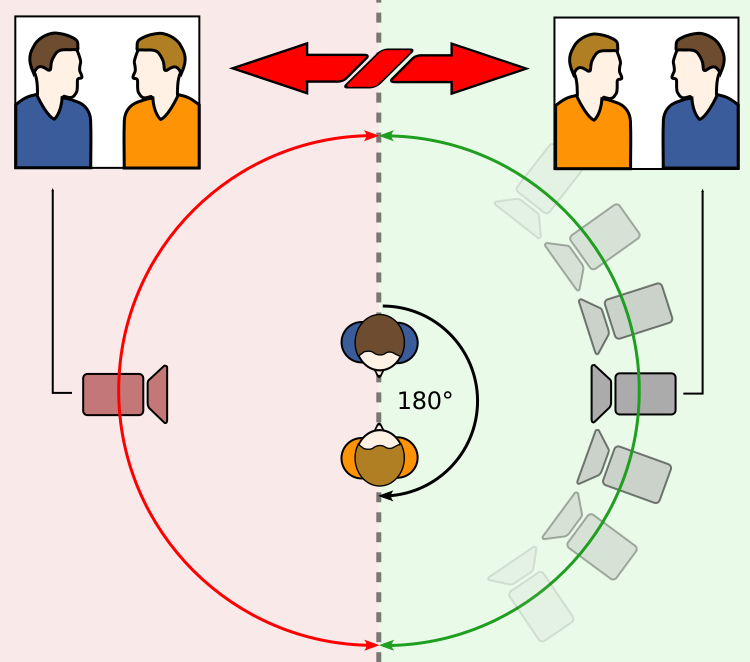
First let's start with the 180 degree rule. Here's a quick diagram to explain briefly what it's all about. 

The basic principle of this rule is that the camera never travels beyond 180 degrees from an invisible line between the two characters. In a walking shot this is used to make sure that the characters are always walking left to right, or vice versa. In a conversation situation this rule is used to make sure the characters have set positions, for example: the woman character (Bella Swan) will always be seated on the left, and character 2 (Edward Cullen) will always be seated on the right. If the camera was to disobey this rule? The two characters would switch positions, making the shot confusing.


Shot Variety
Next, let's look at shot variety. Throughout a conversation, the most common shots are: mid shot, over the shoulder, master shot. By using these we become familiar with the characters as it focuses more on their face and less on the setting around them. Also by using different types if angles and shots this adds interest to the audience and keeps them interested on what's going on. Examples of these shots used in the clip are as follows:


1. Here, we have a master shot of the two characters. This gives us a feel of the setting/situation that they're in. In this case they're in a science lab, in high school. This gives us a sense of informality and we instantly know nothing serious is going to happen. Also, we can see the structure of how the two characters are sitting from each other. So in this case they are side by side but not too close or touching so we can tell that they aren't a couple and maybe are just friends.
2. Next, we have a mid shot of Bella and in contrast a mid shot of Edward also. In Bella's shot it is seen as in the eyes of the character if Edward. This makes us see what the character is seeing, and understand what the character focuses on (for example in this shot he's focusing on her face). 


In the mid shot of Edward, it is from the view of the front of the class. Even though it being the same shot, by using a different angle from which to shoot it from it makes the scene a lot more interesting. 


3. In this clip there are a lot of over the shoulder clips. By using the over the shoulder technique it makes the conversation a lot more personal. I say this by the means of you are always aware that there's another person in the conversation. And that by using this shot it encloses the two people together as they're in such a small space, all your focus stays on these two. Here are some examples from the clip, of the use of over the shoulder:


 Example 1: Bella, over Edwards shoulder. So the focus is on Bella although we're still drawn to the fact that Edward is still in the shot. Giving both characters importance in the shot.
Example 2: Edward, over Bella's shoulder. So the focus is now on Edward although we're still drawn to the fact that Bella is still in the shot.


Master Shot
Although I mentioned briefly the master shot earlier, I only touched on the importance of it. The master shot contains all the action that happens within a scene. It will often be a long shot when filming two characters. For example in this clip they use a long shot for the master so that we can see both of them clearly and no focus is pulled onto either one of them. 


This is important because it shows the audience very clearly what is happening throughout the conversation, and what's also going on around them, adding setting detail. Also, you can cut back to the master shot throughout the scene repeatedly, so that the audience is always aware of the changes around them as well as in the characters themselves. 


Pick Ups
Which leads us swiftly onto pick ups. These are shots of props, so say a tea cup. these are commonly edited into the scene after the main action has happened, or to fill in the parts where no conversation is present. In this clip, the pick ups used in this sequence is the microscope and petri dishes. These shots are used when the characters aren't speaking, helping the sequence to flow smoothly. Also, with the usage of pick ups we can get a feel of what's going on within the conversation. For example, in this clip we can see by the pick ups that they're involved in a science task to do with a microscope and that they're identifying what are on the petri dishes. This is just extra information which helps build on the conversation itself.


Continuity Editing 
Continuity editing is the process in which we edit the scene to make everything seem much more fluent. For example in the first twelve seconds of the clip we see Bella enter the room, see Edward and then walk over to the desk. However you see Bella do this within two view points. With the use of continuity editing, she is moving in both shots. This links everything together and makes the whole scene a lot more structured and easy to follow. 


Shot/Reverse Shot
A shot/reverse shot is when for example: we have a shot of a persons face, then a shot of their viewpoint and what they're looking at, which leads back to a shot of their face. This is used to make the character important to the scene and draw attention on them and what they're seeing. It is used a lot in this clip of twilight as we are repeatedly switching from shots of Edwards face, to Bella's etc. To me, this makes the scene more personal as we are constantly seeing what the character is seeing, letting the audience build a relationship with the characters on screen.

Sunday, 30 September 2012

How to shoot people walking

When shooting people walking we use a number of different techniques/shots. The one rule involved with this procedure is something called the 180 degree rule. 


It's a basic rule that means that two characters will always have the left to right relationship with each other. When a camera crosses the 'axis' connecting to two subjects it is called 'crossing the line'. The new shot would be the reverse angle.

Here is a diagram to visually show the rule. When the camera goes beyond the green arc onto the red arc, the characters switch and are now standing in reverse.


Different types of camera movement
Tracking shot: camera is on a set of tracks and therefore can go back and forth, below is an example I have found to show this:


Crab: Circular motion around things. Below, is an example of this being shown:


Pan: when the camera only goes side to side (panning the room). Here is an example to show this:


Tilting: when the camera tilts up and down, here is an example to show this:

boom/move up/ move down: the whole camera moves up and down and never goes from side to side, here is a video to show an example of this:

Jib: on a crane and can move up to the ceiling, here is a video to show an example of this:


Dolly: can go anywhere, meaning it can go side to side, up and down, vertical, horizontal etc. Here is an example of the camera moving forward on a dolly:


Example in a movie situation-video used in class


At the start of the clip, a tracking shot is used. This creates the smooth effect of seeing all of the men enter the scene: interacting with each other, smoking, acting in a 'boyish behavior.' Accompanied along with a extra long shot and slow motion technique we  can see the full profile of the characters, and from this make a judgement on what sort of character they may be. As a first impression, we see that they are of some sort of 'gangsters' with the choice of costume (suits and hats) and from the structure and care free way in which they're walking we can see that they're all associated with one another and aren't necessarily of the menacing type.

After this, the camera goes into mid shots of each character individually to introduce them to the movie, an examples of these shots is shown below:
From these shots we can establish many things, one of which that the men in suits are some sort of a gang. The men in glasses seem to be the young 'hot shots' and in the movie the characters that will be most involved in whatever business they may be up to. From here we can assume that the older man in the suit may have been just like one of the younger ones before and may be the leader (so to speak). The man in the sky blue shirt we can guess from his mid shot that he may be a joker among the other men, as he's pulling a comical face, lightning the mood between the other men. The last man (shown on the bottom far right) seems to be an odd ball in association with the others, from this we get the sense that maybe he's less important in contrast with the others?

The last shot that they use to leave the characters with is another extreme wide shot, however this time filming them from behind. This rounds the scene off nicely, as the characters have been shot by: the side, front and back. However, they are careful not to cross the oh so important 180 degree line so that they're always walking in the same direction. Also, by using this shot, we can see a lot of their surroundings and where they're walking too. In this case they seem to be walking to the car, but we can see that they're not surrounded by many people and the place seems quite deserted. 

Example in a different movie situation 


Compared to the reservoir dogs, we see a more complex way of filming someone walking. In this video they use a number of different techniques not just focusing on the movement of the people walking, but also the reactions of the people around them too. This clip has a lot more in the surroundings and background and therefore aesthetically creates a pleasing effect.


We first see the characters enter through a door, the camera starts at a high angle and uses a jip shot (where the camera is on a crane and can go up to the ceiling) to almost a semi circle in front of the characters so that it finishes at eye level with the characters. It finishes on a mid shot so that we can see the emotional responses on their faces more clearly, whilst also taking in a first impression of what they all look like. The situation of the clip is that these girls are being presented to the school of Hogwartz as competitors for the Tri-Wizard cup. Their emotional responses in this shot is that of almost snobbery. They're putting across the image that they aren't afraid and the mid shot compliments this quite well.


Here is a flow chart of the shots used within the walking sequence.
In comparison to the Reservoir Dogs, the shot varieties in this sequence vary a lot more. By doing this, it keeps the viewer more interested in what's going on however the amount that is going on in the shot is quite overwhelming.

We start with a shot behind the characters, also a mid shot so when they make the transition of seeing the girls from the front, to seeing them from the back, it seems smoother as they're both mid shots. Next, we see the girls from both sides (first the right and then the left), as they dance along the side greeting themselves to the passing students at the table. And again, just like with the mid shots of them entering the hall, they shoot these from the front and behind, getting both perspectives of the students sitting on the tables as well as adding interest to the whole sequence as we aren't constantly seeing the same view point in every shot. The next shot we see is another mid shot but of the characters bottom half's from behind, this goes with the the characters over voice adding humour to the extract and therefore keeping the viewers interested in what's going on around them as well as with them.

From this, we then get a view of the girls all in a different structure from the front. The constant changing of shapes that they're positioned in and angles in which the image is shot almost to disorientate the viewers into what the girls are doing, making the whole sequence more surreal and fitting into the them of the movie (fantasy). This is a mid shot and from this we can also see the reactions on the faces of the girls, as they're trying to be graceful whilst birds are fluttering around them making a nice effect.

Almost like the Reservoir Dogs, we finish with a wide shot. Although this sequence is shot from the front whereas in contrast Reservoir dogs was shot from behind. From this we get a final look at the room surrounding them, with all of the students cramped into this one hall. This echoes in the rest of the shots as everything seems very full, with tight shots fitting in all the different characters.

Camera angles and shot types

There are twelve main camera angles/shots. Here are the names, explanations of how the shots are taken/what they are and what importance they hold within the whole film with example  pictures of them:


Extreme Close Up
An Extreme close up is a shot which focuses on one single part, for example an eye. This would be used to enhance the dramatic expression on someones face.


Close Up
A close up is a shot showing the full face, showing more than an extreme close up. This may be used in a film to show more of the personality/emotion on the characters face. It helps you to know more about the character as well.


Mid Shot
A mid shot is a shot which focuses on the face and shoulders. This may be used to keep the character in the main focus, however trying to bring in more of the surroundings that they're in, making you more aware of the situation.


Long Shot
A long shot is a shot that shows the whole character, from head to foot.This shot may be used to introduce the characters surroundings a lot more and show what they're wearing. This can help to identify the character for example: Someone wearing a sheriffs outfit we would stereo-typically know that he was an important officer and the film was maybe that of a western era. All of this can be told from a long shot and not of say a close up.


Extreme Long Shot
An extreme long shot is a shot which takes into account the full body of the character however shoots them from further away to allow the surroundings to make an appearance  This can be used to make the character seem more insignificant in contrast with the surroundings. It lets you focus less on the person and more on what's going on around them.


Tilt shot
A tilt shot is a shot which is taken on the tilt. This can be used to add more interest to the picture/film. It gives the piece a strange feel and keeps interest in the consumer.


High Angle Shot
A high angle shot is taken from a high angle just above head height. This can be used to make the character seem smaller compared to other characters, as well as maybe put more importance into them as it's a single shot focusing on them still.


Low Angle shot
A low angle is shot from below, at for example  the feet area. This can be used to make the camera seem bigger and therefore more important, and is in direct contrast with the high angle shot.


Eye level
The eye level shot is a angle that's taken at the characters eyes. This can be used to make the character directly interact with the audience, and draw them into the emotion that they're expressing. It brings all the attention onto the one character and is very effective in movies.


Birds Eye View
This is shot from a birds point of view, so ver high up looking directly down on the person/thing. This makes the character seem insignificant in comparison to the surroundings as they're portrayed as so tiny.


Worms Eye View
This shot is taken from down below, with the camera on the ground so you can get the lowest shot possible. This in effect can be used to make the character to seem bigger than they actually are which enhances their importance as well as making them seem more intimidating due to their size.


Over The Shoulder Shot
This shot is taken from behind a characters shoulder, to show yet another character. This is used to draw attention (using the picture as an example) the baby, making them the center of our attention, however the shot also allows us to remember there's another character there too.

Tuesday, 18 September 2012


This is a photo from another website onto my blog.