Above, we have a map to show how different thrillers all inter-combine with each other. The movies I have chosen to use are: Casino Royale, Taken, Essex Boys, Batman, Spiderman, Law Abiding Citizen, Kill Bill, Layer Cake, Who Framed Roger Rabbit, Double Indemnity, L.A. Confidential, The Third Man, L.A. Noire and finally China Town. All of these are well known thrillers within the industry, some more famous than others however aspects of each linked with another. The features that I have chosen to associate the films with are: Voice overs, violence, femme fatale and deceit.
Although rather complicated to look at, this map is in fact quite simple. For, in the top right hand corner we have a key, explaining what colour lines mean, for example: purple = violence. Then from this, every movie that is placed on the purple line will involve violence within its content.
This is a very easy way to compare thrillers together, for we can see what qualities they have in common, what they may differ from, to form quite a detailed analysis of thrillers in general. For example: from looking at the map we can see that the red line crosses with a lot of movies, we then look at they key and see that this is representing deceit, and so we can conclude that most thrillers have a key aspect of deceit in them.
Saturday, 24 November 2012
Friday, 23 November 2012
Noir characteristics in 'Who framed Roger Rabbit'
Plot/Genre
Brief summary of plot: 'Toon star Roger is worried that his wife Jessica is playing pattycake with someone else, so the studio hires detective Eddie Valiant to snoop on her. But the stakes are quickly raised when Marvin Acme is found dead and Roger is prime suspect. Groundbreaking interaction between the live and animated characters, and lots of references to classic animation.'
The plot itself offers a lot for the noir genre, it includes: crime, deciept, investigators, thrill and ofcourse a dark twist. The dramatic and quite classic effect that is portrayed through combining the classic noir to classic animation is a complex contrast that keeps the movie from being a fatal disaster. Ofcourse, the animation is not noir in the slightest, however it is a fantastic comedy affect within the movie.
For the start of the the trailer we are shown an old and classic cartoon that many of us will relate to from our childhoods. Something about this keeps the sequence from being too much? (a little over dramatised maybe?) In my opinion it's the vintage scratches, and not quite high definition picture that we are all so used to nowadays, and although this is not a direct link to the noir genre, it does remind us of the time period it was made in. From this we are entered into the surreal world where the animation and the living, are habitated as one. The only real noir feature we can take from this, is the idea of disorientation. This is used quite effectively in noir movies to make the scene look more dramatic, frightening etc. However in this they use it to confuse you about what is real and what's not, for we have cartoon characters and real characters so how can we tell if what they're doing is real or not?
Costume
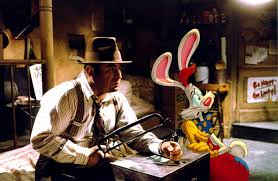
Following on from the cartoons, we are introduced to this glamorous fifties style life, (very noir) misconceding the brutal murder that is to take place within the story. We are introduced to the protagonists of the story (both male -very stereotypical for the time period for the men to be the heroes of the story and very noir in itself) in the form of a cartoon rabbit, and an investigator. The investigator is in the stereotypical bold hat, long coat, shirt, tie etc. oozing investigator. The personality of the investigator, although quite humorous, is that of a cold nature. He has no intention of helping Roger and quite forcefully tries to tell him no. This is very noir as it delves into the personality of what an investigator should be like: tough minded and not putting up with any un-needed business. However, quite unlike noir it does allow him to show a soft side throughout the movie, making the character more approachable and loveable in the eyes of the audience.
Not only do we have the rather striking costume of the investigator, we also have the stereotypical gangster look on the animated creatures (antagonists) and this is really exaggerated that they're the criminals as they're made to walk with arrogance, smoking a ciggarrette and talking like they own the place. The idea of being arrogant and the stereotypical dresswear echoes the noir genre very much so.
Setting/Surroundings
Other settings that are very stereotypically noir are: bar, crime scene, old warehouse, and artificially lit (creepy) street. These are all exaggerated in this movie painfully so that even the simplest of minds could understand what they're trying to portray. For example, in the crime scene we are shown with a white drawing of the where the body should be with a safe planted on the floor next to it. Not so noir. But keeping to it's comedy value, as this isn't all a serious movie after all. In the bar scenes, we do see the aspect of dim/artificial lighting take place as the scene is meant to seem more sombre and mysterious. The usage of 50's style costume, dim lighting and props within the bar creates a brilliant scene in which to capture the story in.
The greatest of femme fatales and probably the most famous one in the animation history we are introduced to the great female character of Jessica Rabbit. At the start of the movie, the detective is hired to keep an eye on Jessica as she was seen to be an unfaithful wife, meddling with another man. Already we see a clear theme of deciept and power (all in her court ofcourse). She is a character that takes charge and gets her own way. This is a perfect example of femme fatale and a prime example of noir features. By using her wistful ways, and rather tempting figure, she flirts her way through the system, making any man believe what she wants them to believe. Although not killing anyone herself, and not being human, she could have quite easily replaced any femme fatale in a noir movie being a key seductress.
Choice of Main Character
The main character is that of Bob Hoskins. This actor was chosen particularly well as in the 1980's his career really set off with famous titles such as: The Long Good Friday (1980), The Cotton Club (1984) and Mona Lisa (1986) all in which Bob is playing the stereotypical gangster/investigator. With experience in this style of role, to recruit him into a noir style movie was a great investment. Not only this, but also stereotypical English movies, accents are part of his fortay, this is accentuated when he is made to do an american accent in Roger Rabbit. All in all, the very style of this film goes well with the experience of films that Bob Hoskins has had to play in the 80's.
Monday, 19 November 2012
How does LA Noire use features of Film Noir?
L.A. Noire is a play station game based on the stereotypical 'gangs of New York' with the person playing being the detective, and we are set out to investigate a number of different cases ranging from homicide, suicide, etc. Having had the chance to experience the game, the cases are quite intense and realistic and breach to be as life like as any cartoon can be. Above is a collage of images taken from the game to give a visual of what it contains.
In context with the noir genre, many of it's qualities overlap. For a start, with the opening credits of the video game we have this classic font, very simple and effective. This also promotes this sort of glamorous lifestyle, (noir glamour) and this is closely followed by an introduction of the game. Below is a clip of the opening to the game:
Here we have a classic noir opening. The 50's setting, costume and music all intertwine with some expressionist jazz to create a glamorous lifestyle for all to ponder and dream of having. This comes with the brutal reality of the gangsters involved in the game, and the horrific cases involved. This is portraying the noir theory that being a gangster is almost glamorous in itself and something to look up to and almost praise rather than be afraid of. As well as this, we have a narrative device in the form of a husky voice over explaining the story we have another classic noir trait. Along with this we are fed the line: 'Who do you trust' with a very melancholy voice, giving a dark twist to the almost light mood that they've been portraying so far.
Moving away from the opening and more into the game itself we start to unwrap more features that are quite strikingly alike to the noir genre. First, we are introduced to the investigators desk where we are shown a number of props, these include: gun, magnifying glass, folders, cigarettes etc. This is a stereotypical desk for any investigator in America and also very stereotypical for a noir investigator. Not only this, but many of the landscapes/settings used are spoiled with noir features, leaking this image of filthy, dirty and dark surroundings with: dim lighting, heavy shadows all topped off with a full moon to leave us with a lasting noir impression. We can see this by example in some of the pictures in the collage above. A great example of the dark shadows, is the top left where we see a man hiding around a corner with a very sharp shadow across his face creating moral ambiguity, also very noir.Another similarity is that of the camera work. With the camera constantly moving, we are introduced to a very disorientated/eery effect within the scene, this only enhances the situation in which we are playing in. This is very noir as we have the dark story line, complimented by the shady camera work to make everything very confusing and surreal. Not only this but the camera movement uses the rule of thirds, keeping the characters to the points on the screen where our eyes are naturally drawn to.
This video game can closely relate to a rather famous noir film named 'The Third Man'. Like the Third Man, we see the use of torches to create a spotlight, paired with ambient and low key lighting. Most of the characters are also lighted from the back, creating an artificial effect commonly used in noir. In this clip, we have an example of the Third Man techniques used.
From this clip I will be using the times from 0:00 - 5:33. The first indication that we see that it is using The Third Man techniques is the small claustrophobic space in which the character is entering in. We also see the use of artificial being made as a spotlight is drawn above the characters head. Not only this, but in true Third Man style, we have nearly an exact replica of a shot used in the movie:
![]() |
Not only this but the constant use of the flash light from the character is quite commonly used in most noir movies, and especially in The Third Man. The action that's happening around the character with other contributing characters as well as the movement of the lighting and camera can also be closely related to The Third Man with specific analysis.
How has Working Title adapted its films and marketing for different audiences?
Working Title was founded in 1984 by Bevan and Sarah Radclyffe and in 1992 went looking for a corporate backer. Polygram was the chosen lucky one, and this is when Fellner came on board, Radclyffe having left. Working Title was joined with Polygram from 1991-1999 and in 2000 Working Title was bought by Universal Studios (2000-present). During research I had taken on Working Title I found a quote from Bevan himself explaining the struggle they had finding a corporate backer:
''Before that we had been independent producers, but it was very hand to mouth. We develop a script, that would take about 5% of our time; we'd find a director, that'd take 5% of the time and then we'd spend 90% of the time trying to juggle together deals from different sources to finance those films. The films were suffering because there was no real structure, and speaking for myself, my company was always virtually bankrupt.''
Working Title is a British film production company, based in London (although also having locations in Ireland and L.A.). It produces feature films and several television productions. Having started off as a small company, Working Title's choice to be bought by Universal gave them a huge advantage in marketing opportunities for different audiences, seeing as Universal has its own distribution and therefore can offer more. During this transaction a number of changes were made to the way the company reacted. As the film industry hit a polarization, the industry went two ways. The first: high budget, action packed, thrillers, mainly used for a global audience and the second: low budget, quite simple filming however complex script/story line, aimed at more of a European market than global. The path that Working Title chose to take was the low budget.
With the income of $75 million being made in the past with films that have what we call 'niche' markets, a big budget can be allowed due to the fact that box office is guaranteed a good feedback. Examples of movies that show this would be: Harry Potter, Twilight, James Bond etc. and these are usually for a global market. However, nowadays $30 million is being made instead, explaining why such low budgets are being used so that more can be made in the box office and ultimately a profit made. Working Title (as established in the paragraph above) is a low budget marketing/production (with the odd exception such as Atonement) and is funded by Studio Canal heading towards a European market.
Although some may see a lower budget as a hinder to the movie, Working Title played it to their advantage. They achieved this by focusing more on the script and the way in which the movie is directed than the special effects, and over americanised characteristics which most films seem to be displaying nowadays. This creates a more focused target audience, however with the expertise of marketing, and with enough publicity before and after the movie has been released, a lot of money can be made.
Examples of low budget movies that have stirred enough attention for any feathers to be ruffled, we have: Billy Elliot, About a Boy, Bridget Jones' Diary and Notting Hill. These are all quite famous movies, that required a low budget. These movies are all quite stereotypically British, using British: actors, landscapes, costume, stereotypical British attitudes, etc. This is not only appealing to the British market, it is also very popular for the American market. Americans are fascinated by the British and therefore being publicised there brings in a lot of income for Working Title. A very famous movie that is low budget however worked for a global market is Mr Bean. This was distributed around the world and was very successful because of the well known main character, stupidly British and bluntly humorous so that different countries can easily understand the comedy of the scene without having to know the language of the film.
''Before that we had been independent producers, but it was very hand to mouth. We develop a script, that would take about 5% of our time; we'd find a director, that'd take 5% of the time and then we'd spend 90% of the time trying to juggle together deals from different sources to finance those films. The films were suffering because there was no real structure, and speaking for myself, my company was always virtually bankrupt.''
Working Title is a British film production company, based in London (although also having locations in Ireland and L.A.). It produces feature films and several television productions. Having started off as a small company, Working Title's choice to be bought by Universal gave them a huge advantage in marketing opportunities for different audiences, seeing as Universal has its own distribution and therefore can offer more. During this transaction a number of changes were made to the way the company reacted. As the film industry hit a polarization, the industry went two ways. The first: high budget, action packed, thrillers, mainly used for a global audience and the second: low budget, quite simple filming however complex script/story line, aimed at more of a European market than global. The path that Working Title chose to take was the low budget.
With the income of $75 million being made in the past with films that have what we call 'niche' markets, a big budget can be allowed due to the fact that box office is guaranteed a good feedback. Examples of movies that show this would be: Harry Potter, Twilight, James Bond etc. and these are usually for a global market. However, nowadays $30 million is being made instead, explaining why such low budgets are being used so that more can be made in the box office and ultimately a profit made. Working Title (as established in the paragraph above) is a low budget marketing/production (with the odd exception such as Atonement) and is funded by Studio Canal heading towards a European market.
Although some may see a lower budget as a hinder to the movie, Working Title played it to their advantage. They achieved this by focusing more on the script and the way in which the movie is directed than the special effects, and over americanised characteristics which most films seem to be displaying nowadays. This creates a more focused target audience, however with the expertise of marketing, and with enough publicity before and after the movie has been released, a lot of money can be made.
Examples of low budget movies that have stirred enough attention for any feathers to be ruffled, we have: Billy Elliot, About a Boy, Bridget Jones' Diary and Notting Hill. These are all quite famous movies, that required a low budget. These movies are all quite stereotypically British, using British: actors, landscapes, costume, stereotypical British attitudes, etc. This is not only appealing to the British market, it is also very popular for the American market. Americans are fascinated by the British and therefore being publicised there brings in a lot of income for Working Title. A very famous movie that is low budget however worked for a global market is Mr Bean. This was distributed around the world and was very successful because of the well known main character, stupidly British and bluntly humorous so that different countries can easily understand the comedy of the scene without having to know the language of the film.
Analysis of Submarine trailer: 'What are they selling?'
Our first impressions of the trailer is that the genre of the film is one of: coming of age and comedy type of movie. This comes through thick as the story line is revealed as a: teenage boy (the stereotypical type with a few differences here and there) goes through his life wishing that he was noticed more. He finds a girlfriend, they break up, and here we have his life. Still on first impressions and going from the raw story line that we can gather instantly, the movie could be said to be compared to 'Diary of a wimpy kid' (a well known blockbuster) however with more of a narcotic twist to it. We can take our target audience from this, ranging from mid teens (16+) to late twenties early thirties? It's hard to tell exactly the ages it will appeal to due to personal preferences, but with the evidence from the clip we can see that late teenagers can understand the humour, as they've been through it not long ago. For the late twenties/older thirties, they also can watch the movie and reminisce how their teenage years fared and although not in the same way as the teenagers, can somehow relate to the movie themselves.
Instantly we can see this is an independent film as there are no special effects, nearly all of the shots we see are on location, and the feel of the movie is very raw. This idea of an independent movie is then reassured when we see the opening credits publishing the companies behind the movie being: The Weinstein Company, Film 4, and the national lottery.
Not only is this trailer selling us: a target audience, comedy/coming of age genre, and a fabulous 80's lifestyle, we also get a projection of love interests. Although not stereotypically shown as we see nowadays in romcoms, it's still present due to nearly all of the trailer devoted to Oliver expressing his undying love for a girl. However, the feelings are not reciprocated, selling the audience a love that no doubt they've experienced. This concept of someone that we love so much, and they don't feel the same is so easily related to, complimenting the coming of age genre quite nicely.

At the start of the trailer, the soundtrack doesn't start until the companies are shown. Instead, we are introduced by the sound of type writing, an occurring theme throughout the trailer. This gives the movie an 'old school' touch, as type writers were commonly used years ago when computers weren't invented. This helps us with the time period, and therefore is selling to the audience the 80's lifestyle.
On the left are the examples of the type writing effect used within the trailer, to help create the 80's feel:
Wednesday, 14 November 2012
In 'The Third Man' sewer scene, how is claustrophobia and disorientation created?
Brief summary of The Third Man
The Third Man is a great example of a Noir film. It characterises all that is Noir with the stereotypical shadows, the dark story line, and so on. The plot to The Third Man is:
'An out of work pulp fiction novelist, Holly Martins, arrives in a post war Vienna divided into sectors by the victorious allies and where a shortage of supplies has lead to a flourishing black market. He arrives at the invitation of an ex-school friend, Harry Lime, who has offered him a job, only to discover that Lime has recently died in a peculiar traffic accident. From talking to Lime's friends and associates Martins soon notices that some of the stories are inconsistent, and determines to discover what really happened to Harry Lime.' With actors such as: Joseph Cotten, Orson Welles and Alida Valli and a director of Carol Reed, it has a famous cast, making the film a popular success.
There are six different aspects in which the techniques can be categorised into, these are: sound, location, lighting, editing, camera and action. It's with these different aspects in which the atmosphere is dramatically controlled, and therefore can project the feeling of claustrophobia and disorientation towards the viewer.
Below is the full video of the sewer scene taken from 'The Third Man':
Sound
Sound is a very key aspect to the claustrophobia/disorientation effects that are being made in this scene. Sounds are constantly around us, and in this movie the dramatic extent to which they use this technique is to quite a phenomenon. The different sounds that we can distinguish from the clip are:
Disorientation is also made by the different accents being used. On the outside of the tunnel we here distinct German accents, calling for the police to go into different entrances to the sewers and then on the inside of the tunnels we here English accents. This contrast in different languages is enough to disorientate any normal person in a perfectly simple situation, so when you put the cross of dialect to a man running from police in a completely unknown setting? Then disorientation is quite obvious.
There is a great extract from the clip where Harry is near to freedom and his hand is stretching out from the drane. Here, all the other noises are cut from the scene and just the sound of wind blowing on his fingers is left lingering in the scene. This gives a sense of freedom to the character, although this freedom is short circuited . However, still enforcing the claustrophobia concept as his fingers are being squeezed through such a small space and such little of his fingers are being shown making it a very tight shot and the feeling of being very enclosed.
Another great extract from the scene is where harry is in the middle of the tunnel and is surrounded by different openings, one of which will be sure to lead him to freedom, however sounds are coming from every direction of people shouting and running and talking that either entrance could lead to a fatal disaster. Referring back to the video, this can be scene at the time of 6:19 minutes - 6:48 minutes. This is disorientating in itself, as each entrance brings another voice, as well as another accent, and of which entrance it's even coming from he's unsure of. The thought of the voices closing in on him also can bring about the claustrophobia concept.
Editing
Editing helps with the disorientating of the characters with the scene mentioned above in the sound section. Through the time of 6:19 minutes and 6:48 minutes the editing of the film helps to create the illusion that all of these people are saying these different things through different openings, making disorientation a key aspect.
Also, the constant changing of overground to underground shots makes the whole scene contrast. By showing the overground scene as very open and free, when they cut to the underground scene everything becomes a lot more enclosed and inevitable.
Camera
The use of different angles and shot types within this sequence leads to a most intriguing sight. the first technique i'm going to be focusing on is the use of tight shots. All through the clip we see multiple characters in tight spaces, as the camera focuses in and makes everything seem claustrophobic.
Above are a few examples of the tight shot I mentioned. In nearly all of these shots they are using a close up or mid shot. This in itself is used to show emotional responses, and in this situation using a mid shot just enhances the panic harry feels and the urgency the policeman feel to try and get this man. However, in the bottom left hand corner, they don't use a mid shot but yet use a long shot. Even though it's shot from further away it still gives the feeling of entrapment as it's only given a little space for the character to be seen in. This gives a sense of little space in the setting, enhancing the whole claustrophobia effect.
The next technique I'm drawing focus to is the movement of the camera. Throughout the scene the camera doesn't actually move, but stays still for the most of it. This allows the characters to run in and out of the shot. This doesn't create an effect of claustrophobia as such, but can make the viewer disorientated as we will see one group of policeman running in and out of the shot, to another group of policeman doing the same etc. and it may be hard to keep up with who we are watching, and in which direction they're all going. However, the camera does move at certain points, a rather abstract shot that is used is when Harry jumps onto a ladder. Here, they shoot it from almost a worms eye view and make a semi circle motion, swooping underneath him as he jumps onto the ladder. Almost imitating his movement with the camera. This is a very odd shot to use, however works fantastically with the disorientation concept as we're so used to the camera action being still and non-moving (well, with the odd slight movement) that when this is shown, the viewers are left baffled.
Another type of shot they use is a tilted shot. To the left is an example from the sequence. As you can see they used the tilted shot only so slightly, not enough for you to notice that something is somehow awkward about the setting, but enough for it to look unusual. With this slight tilt, it makes the shot disorientated in itself, and complimented with all the confusion of the action in which this shot is sandwiched with, disorientation is a major factor.
Action
Throughout the sequence, the feeling that there is a lot going on all at once comes across very strongly. However, action wise? There really isn't much in variety to comment about. Although! It isn't about quantity, it's about quality and this video is packed with it! The main actions that we see throughout are:
Due to this being a noir style film, we can tell instantly that lighting will have a fantastic effect on the mood/atmosphere of the scene and ultimately adding to the disorientation/claustrophobia affects I'm discussing. First we notice that a lot of artificial light is being used from the torches of the policemen. This luminates a specific spot in the scene making the image seem fragmented and therefore disorientated. This effect can also make the illuminated image seem enclosed and quite tight, bringing in also the claustrophobia effect. An example of this is shown on the right. Here, we can see the flash light acts as a vanishing point, allowing us only to see the edges of the tunnel around the shaft of light that is at the opening of the tunnel. This makes the scene seem very claustrophobic as we can't see the whole surroundings, putting us out of our comfort zones. The aspect of the darkness makes our eyes strain, also putting us outside our comfort zone and therefore making us more disorientated as we try to focus on images in the dark.
The Third Man is a great example of a Noir film. It characterises all that is Noir with the stereotypical shadows, the dark story line, and so on. The plot to The Third Man is:
'An out of work pulp fiction novelist, Holly Martins, arrives in a post war Vienna divided into sectors by the victorious allies and where a shortage of supplies has lead to a flourishing black market. He arrives at the invitation of an ex-school friend, Harry Lime, who has offered him a job, only to discover that Lime has recently died in a peculiar traffic accident. From talking to Lime's friends and associates Martins soon notices that some of the stories are inconsistent, and determines to discover what really happened to Harry Lime.' With actors such as: Joseph Cotten, Orson Welles and Alida Valli and a director of Carol Reed, it has a famous cast, making the film a popular success.
There are six different aspects in which the techniques can be categorised into, these are: sound, location, lighting, editing, camera and action. It's with these different aspects in which the atmosphere is dramatically controlled, and therefore can project the feeling of claustrophobia and disorientation towards the viewer.
Below is the full video of the sewer scene taken from 'The Third Man':
Sound
Sound is a very key aspect to the claustrophobia/disorientation effects that are being made in this scene. Sounds are constantly around us, and in this movie the dramatic extent to which they use this technique is to quite a phenomenon. The different sounds that we can distinguish from the clip are:
- water running
- banging/echoed voices
- wind
- feet pounding on the floor
- German/English accents
Disorientation is also made by the different accents being used. On the outside of the tunnel we here distinct German accents, calling for the police to go into different entrances to the sewers and then on the inside of the tunnels we here English accents. This contrast in different languages is enough to disorientate any normal person in a perfectly simple situation, so when you put the cross of dialect to a man running from police in a completely unknown setting? Then disorientation is quite obvious.
There is a great extract from the clip where Harry is near to freedom and his hand is stretching out from the drane. Here, all the other noises are cut from the scene and just the sound of wind blowing on his fingers is left lingering in the scene. This gives a sense of freedom to the character, although this freedom is short circuited . However, still enforcing the claustrophobia concept as his fingers are being squeezed through such a small space and such little of his fingers are being shown making it a very tight shot and the feeling of being very enclosed.Another great extract from the scene is where harry is in the middle of the tunnel and is surrounded by different openings, one of which will be sure to lead him to freedom, however sounds are coming from every direction of people shouting and running and talking that either entrance could lead to a fatal disaster. Referring back to the video, this can be scene at the time of 6:19 minutes - 6:48 minutes. This is disorientating in itself, as each entrance brings another voice, as well as another accent, and of which entrance it's even coming from he's unsure of. The thought of the voices closing in on him also can bring about the claustrophobia concept.
Editing
Editing helps with the disorientating of the characters with the scene mentioned above in the sound section. Through the time of 6:19 minutes and 6:48 minutes the editing of the film helps to create the illusion that all of these people are saying these different things through different openings, making disorientation a key aspect.
Also, the constant changing of overground to underground shots makes the whole scene contrast. By showing the overground scene as very open and free, when they cut to the underground scene everything becomes a lot more enclosed and inevitable.
Camera
The use of different angles and shot types within this sequence leads to a most intriguing sight. the first technique i'm going to be focusing on is the use of tight shots. All through the clip we see multiple characters in tight spaces, as the camera focuses in and makes everything seem claustrophobic.
Above are a few examples of the tight shot I mentioned. In nearly all of these shots they are using a close up or mid shot. This in itself is used to show emotional responses, and in this situation using a mid shot just enhances the panic harry feels and the urgency the policeman feel to try and get this man. However, in the bottom left hand corner, they don't use a mid shot but yet use a long shot. Even though it's shot from further away it still gives the feeling of entrapment as it's only given a little space for the character to be seen in. This gives a sense of little space in the setting, enhancing the whole claustrophobia effect.
The next technique I'm drawing focus to is the movement of the camera. Throughout the scene the camera doesn't actually move, but stays still for the most of it. This allows the characters to run in and out of the shot. This doesn't create an effect of claustrophobia as such, but can make the viewer disorientated as we will see one group of policeman running in and out of the shot, to another group of policeman doing the same etc. and it may be hard to keep up with who we are watching, and in which direction they're all going. However, the camera does move at certain points, a rather abstract shot that is used is when Harry jumps onto a ladder. Here, they shoot it from almost a worms eye view and make a semi circle motion, swooping underneath him as he jumps onto the ladder. Almost imitating his movement with the camera. This is a very odd shot to use, however works fantastically with the disorientation concept as we're so used to the camera action being still and non-moving (well, with the odd slight movement) that when this is shown, the viewers are left baffled.
Another type of shot they use is a tilted shot. To the left is an example from the sequence. As you can see they used the tilted shot only so slightly, not enough for you to notice that something is somehow awkward about the setting, but enough for it to look unusual. With this slight tilt, it makes the shot disorientated in itself, and complimented with all the confusion of the action in which this shot is sandwiched with, disorientation is a major factor.
Action
Throughout the sequence, the feeling that there is a lot going on all at once comes across very strongly. However, action wise? There really isn't much in variety to comment about. Although! It isn't about quantity, it's about quality and this video is packed with it! The main actions that we see throughout are:
- Running
- Shooting
- Searching
- Stopping and breathing
Although minimum amount of actions are used, they are used quite effectively. To create disorientation within the scene entrapment is used, this sense of trying to find a way of escaping and at each turn there seems to be less hope. Also, the aspect of trying to escape helps with the claustrophobia. For, to see a man constantly searching, in what seems to be such an open wide space can make it seem very small.
The searching of the character Harry compliments the action of the running, enhancing the agitated state in which the police and detective seem to be in not being able to find this one man among nearly a hundred policeman. As well as enhancing the disorientation, we can also use the searching action to compliment the claustrophobia effect. Elaborating on this idea, by using a lot of characters to search for one creates this image of lots of people in small spaces, therefore creating a claustrophobic effect.
Lighting
Due to this being a noir style film, we can tell instantly that lighting will have a fantastic effect on the mood/atmosphere of the scene and ultimately adding to the disorientation/claustrophobia affects I'm discussing. First we notice that a lot of artificial light is being used from the torches of the policemen. This luminates a specific spot in the scene making the image seem fragmented and therefore disorientated. This effect can also make the illuminated image seem enclosed and quite tight, bringing in also the claustrophobia effect. An example of this is shown on the right. Here, we can see the flash light acts as a vanishing point, allowing us only to see the edges of the tunnel around the shaft of light that is at the opening of the tunnel. This makes the scene seem very claustrophobic as we can't see the whole surroundings, putting us out of our comfort zones. The aspect of the darkness makes our eyes strain, also putting us outside our comfort zone and therefore making us more disorientated as we try to focus on images in the dark.
Dark/dim lighting surrounds the images all the way through the sequence, creating dark shadows across the tunnel walls from the characters as well as shadows across the characters faces. In relevance to the shadows across the characters faces, this creates moral ambiguity within the scene as well as helping to disorientate us into who the character is. The deep/dark lighting (as well as being a key noir feature) makes us disorientated as our eyes are not capable of adjusting fast in the dark as quite obviously we live in the light of day, therefore (as mentioned above) the usage of the dark lighting and dark shadows confuses our eyes as we try to adjust.
Above are some great examples of the use of shadows and lighting to create more of a claustrophobic state than disorientation. In the bottom two, we see the shadows line the walls of the tunnels only allowing us to see parts of the tunnel. This is claustrophobic as it gives a sense as in the walls may be closing in or getting smaller due to the lack of sight with them. In the middle picture on the top row, disorientation takes place as we're shown a shadow however we have no body to match it with, therefore it could be that of a policeman's, harry's etc.
Location
Finally, we come to the location/setting of the whole sequence. There are only two locations used, and these are: underground and overground. In the overground scenes we see the city life: the busy buildings, cars moving everywhere. To the contrast of the underground scene: the sewers, tunnels, water running etc. The switch from the open air and the freedom of being overground makes the sewers seem much more closed and trapped, really putting into place the claustrophobia.
![]() |
| From left to right: Overground, Underground |
Friday, 9 November 2012
Subscribe to:
Posts (Atom)